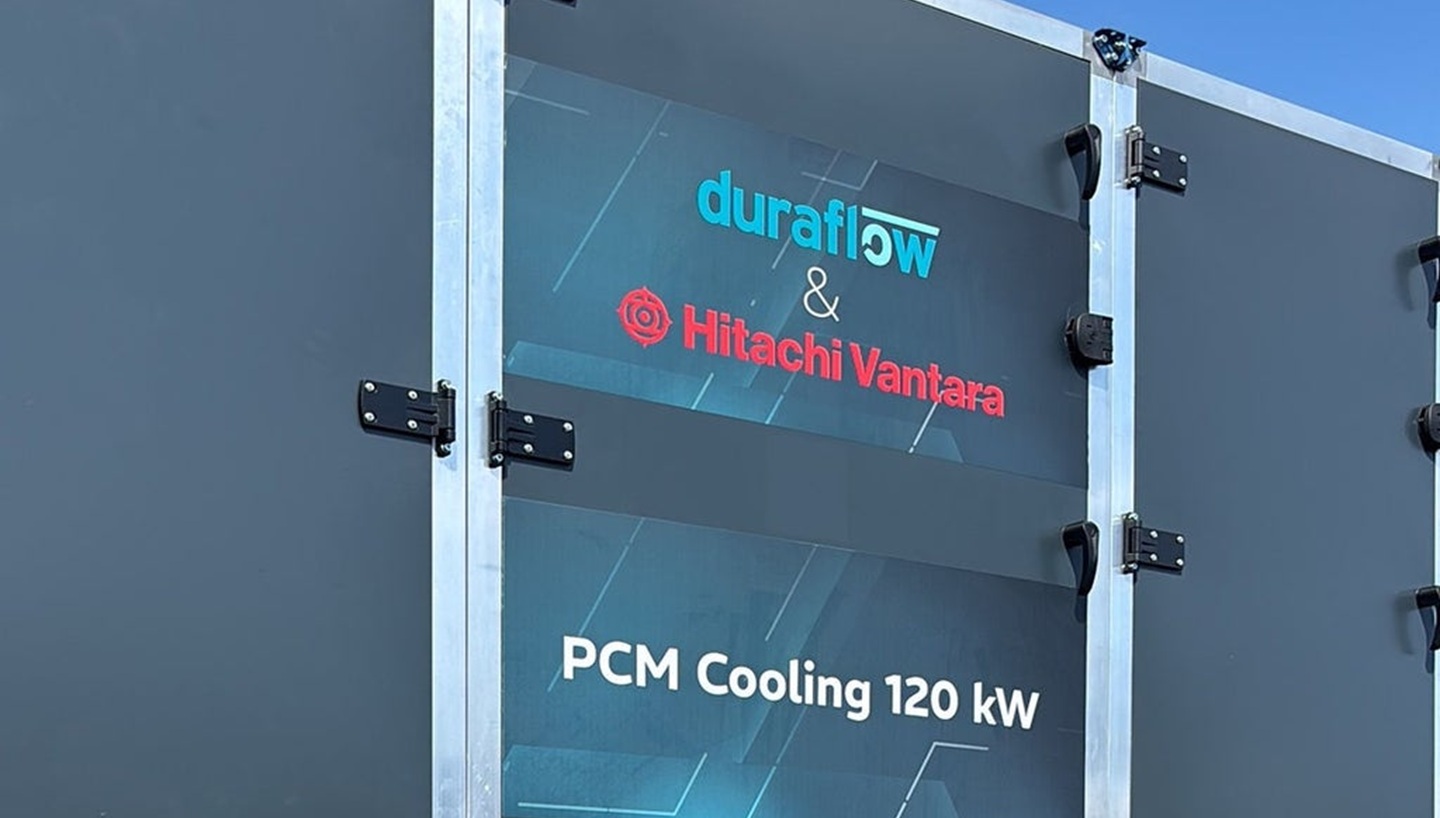
Hitachi Vantara has deployed a Phase Change Material (PCM) installation using Duraflow’s technology at its data centre in the Netherlands.
The data storage, infrastructure and hybrid cloud management subsidiary of Hitachi is using the system to lower the electricity required for cooling, allowing operators to redirect available power infrastructure toward AI and high-density compute workloads.

Access deeper industry intelligence
Experience unmatched clarity with a single platform that combines unique data, AI, and human expertise.
The deployment functions without water and provides 240kW of total cooling capacity across two 120kW units. Operational monitoring indicates that both units collectively draw between 5kW and 8kW of electricity, depending on operating conditions.
By contrast, a conventional direct expansion cooling system providing the same 240kW capacity needs an estimated 60kW to 80kW of compressor power.
Duraflow’s technology uses PCM to absorb heat during periods of peak demand before discharging it in a controlled manner as demand subsides.
This approach eliminates the continuous running of electrically driven refrigeration units.
Depending on the installation, the system can lower thermal management electricity consumption by up to 90%, assisting facilities that face electricity constraints as computing density grows.
Hitachi Vantara business strategy senior vice-president Simon Ninan said: “This project started with a very practical challenge: how do we grow our computing capacity when access to additional electricity is limited.
“We realised that if we could dramatically reduce the amount of power required for thermal management, we could make more of our existing electrical capacity available for computing.
“By partnering with Duraflow, we are demonstrating how smarter energy management can become an important enabler of AI growth.”
The initiative forms part of Hitachi Vantara’s plan to reach carbon neutrality for Scope 1 and Scope 2 greenhouse gas emissions by Financial Year 2030 (FY2030).
The company is also implementing efficiency features across its hardware portfolio, including the Virtual Storage Platform One Block.
This system incorporates a 4:1 Data Reduction Guarantee and Dynamic Carbon Reduction technology, which shifts central processing units into an eco-mode during low activity.
Its continuous compression system can also switch to post-processing, lowering energy use and cutting carbon dioxide emissions by up to 40%.
Last month, Hitachi and Mission Critical Group (MCG) signed a memorandum of understanding (MoU) aimed at developing and expanding data centre solutions worldwide.