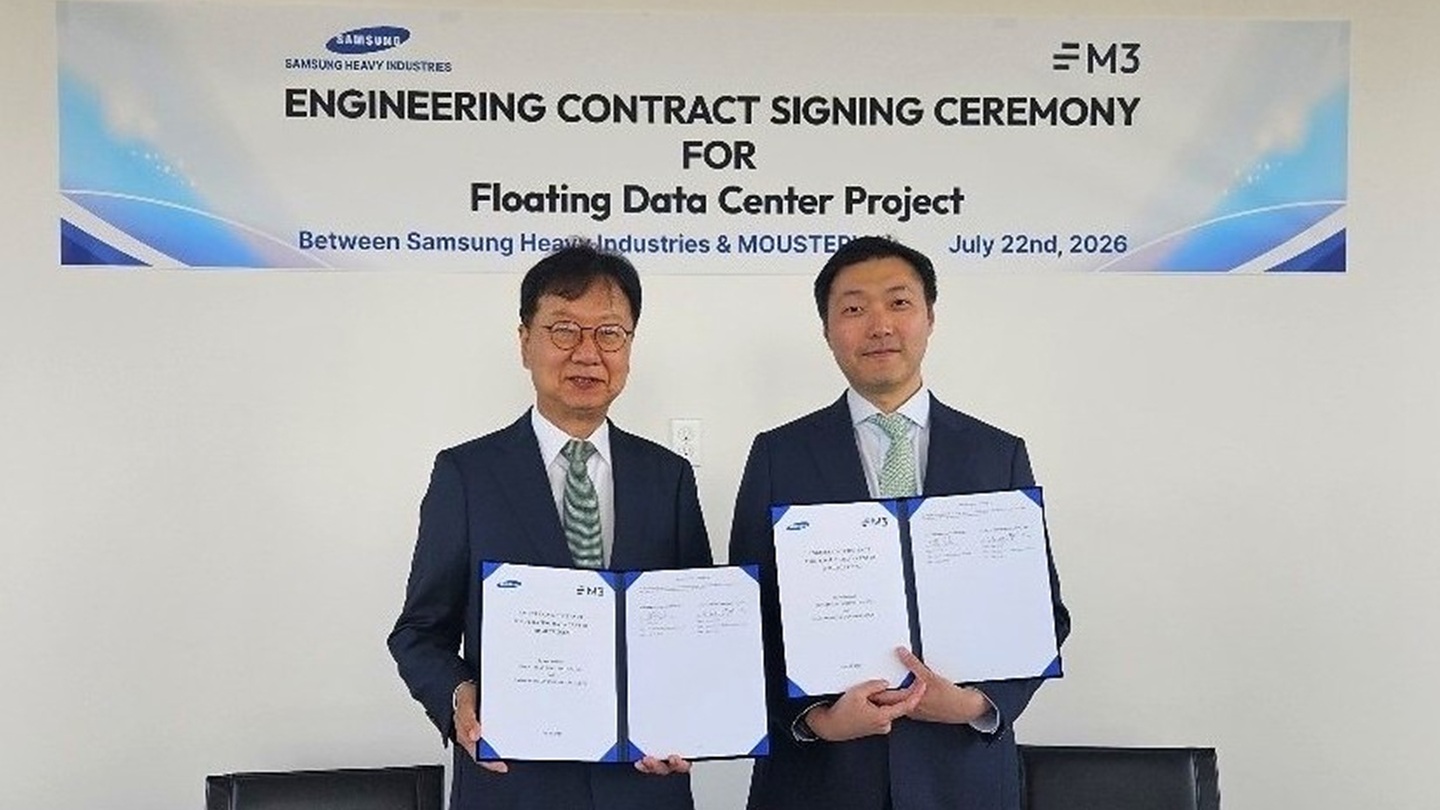
Samsung Heavy Industries and Mousterian have signed an engineering contract for the deployment of their first floating data centre in the US.
Floating data centres are large-scale, watertight structures that float on the surface of oceans, lakes, or rivers.

Access deeper industry intelligence
Experience unmatched clarity with a single platform that combines unique data, AI, and human expertise.
The agreement was finalised at a ceremony on 22 July 2026 and marks the initial project to advance under a strategic cooperation framework set by the two firms in April 2026.
Samsung and Mousterian will focus on designing and engineering purpose-built floating data centre (FDC) units, each designed to provide 50MW of IT capacity. The first deployments are planned for Texas and further unnamed US markets.
The American Bureau of Shipping (ABS) is anticipated to act as classification society for the project.
The new facilities are planned with a focus on sustainability and environmental impact. Each floating data centre will use non-evaporative cooling that does not require potable water and returns zero process discharge into nearby waterways.
The design supports facility-scale, high-density, liquid-cooled AI compute while operating at low power usage effectiveness (PUE).
The omission of conventional air-cooled chillers and fans is expected to allow for quieter operation, reducing noise pollution for nearby communities.
Upon completion of the engineering works, Mousterian and Samsung intend to proceed to a definitive Engineering, Procurement, and Construction (EPC) contract.
This pilot is intended to demonstrate the accelerated delivery and deployment potential of floating data centres located near existing power generation and maritime infrastructure.
By doing so, the project aims to utilise power resources not accessible to conventional land-based data centre developments.
Mousterian CEO Min Suh said: “Signing this engineering contract transitions our partnership with Samsung Heavy Industries from intent to execution and gives us a clear path to scaling factory-built critical IT capacity for AI-class facilities. We are jointly engineering the first mission-critical data centre of its class to be fabricated off-site to shipyard standards.
“Because the facility is built in a shipyard, fabrication advances in parallel with sitework rather than after it — a schedule and scale that conventional delivery methods cannot match. And by siting these facilities alongside existing stranded baseload generation and maritime infrastructure, we reach power that land-based development cannot.”