
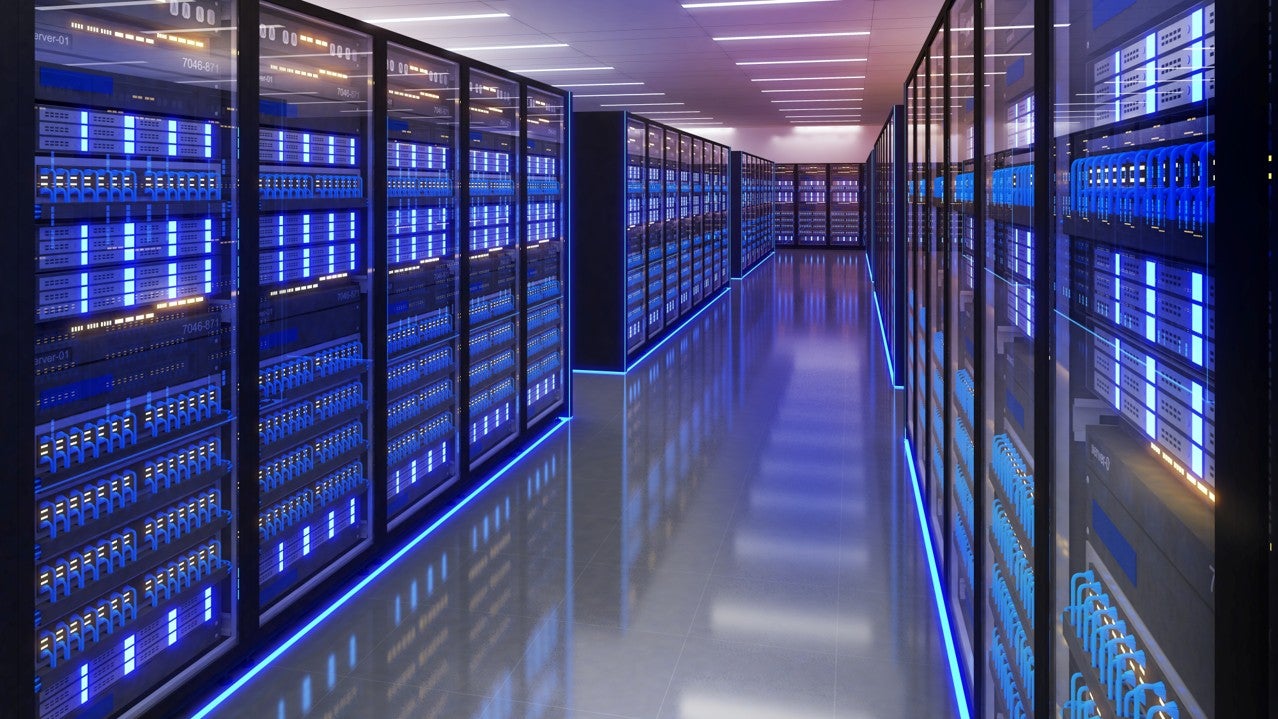
In the age of AI, pharma and tech companies are increasingly joining forces. Inevitably, such collaboration demands a strong digital infrastructure.
Data centre construction has spiked drastically in recent years; over 500 new construction projects had planned starts in 2025, a jump from approximately 300 annually over the previous three years, as per GlobalData’s 2025 report.

Access deeper industry intelligence
Experience unmatched clarity with a single platform that combines unique data, AI, and human expertise.
These sites can be notoriously energy intensive. Data centres accounted for roughly 2.1% of worldwide energy consumption in 2024, and this is projected to more than double by 2030, according to an October 2026 GlobalData report on data centre development. Fossil fuels remain the dominant electricity source, with natural gas and coal accounting for more than 50%, as per GlobalData’s 2025 report.
Beyond greenhouse gas (GHG) emissions, water consumption for liquid cooling systems is a major environmental concern. This is particularly troubling as data centres continue to be built in drought-prone regions like Arizona and Texas in the US, which offer favourable tax breaks, thereby threatening water supplies.
The environmental footprint of data centres can be improved in different ways, including by investing in certain technologies. Still, as AI is increasingly integrated across drug development, pharma and tech stakeholders will need to balance accelerating demand with their sustainability objectives.
Big pharma and big tech converge
The pharma industry’s enthusiasm in embracing AI is reflected in the uptick in partnerships with tech giants. In October 2025, Eli Lilly and NVIDIA announced plans to build pharma’s “most powerful” supercomputer with more than a thousand graphics processing units (GPUs), and more recently, the companies strengthened their ties with a $1bn partnership for an AI co-innovation lab.
In March 2026, Roche launched an AI factory that boosted its total NVIDIA Blackwall GPUs to more than 3,500, which it claimed was the largest GPU footprint for a pharma company.
More recently, Bristol Myers Squibb announced plans to deploy an AI-enabled supercomputer in July 2026, providing the company with the “most powerful and energy-efficient single-owned NVIDIA infrastructure in life sciences.”
While the likes of NVIDIA provide pharma companies with the AI computing hardware for their facilities, many still rely on rented computing capacity from cloud and data centre operators such as Amazon Web Services, owned by Amazon and Microsoft Azure, owned by Microsoft. An Amazon spokesperson told Pharmaceutical Technology that 19 of the top 20 global pharma companies trust AWS to power their sensitive research workloads.
Creating an efficient data centre
As computational demands grow, experts describe several strategies to optimise data centre efficiency and minimise their environmental impact.
According to Martina Raveni, senior analyst at GlobalData, some key steps forward would include matching the cooling mechanism to the workload, moving from evaporative water cooling to closed-loop liquid cooling, and powering operations with renewable energy wherever possible. She also highlights the need for sustainable AI use: deploying smaller models tailored to a specific task and keeping resource-intensive generative and agentic models for the high-value use cases that justify them.
A lot of drug discovery steps do not need the largest, general-purpose AI models, explains Rodrigo Barnes, chief technology officer of agentic AI company Owkin. Using smaller models like Claude Haiku instead of Claude Opus can cut computing requirements for training and running AI, he adds.
Meanwhile, Aaron Yeardley, science team co-lead for Tunley Environmental, a Leeds, UK-based consultancy, believes that every data centre should follow strict climate-measuring rules from the planning stages, as this can allow a company to forecast its total environmental impact and carbon emissions before a data centre is built. He says this will allow companies to “reduce the footprint before actually making it.”
Companies also need to be smart about how a data centre’s infrastructure is used, says Dave Kimberley, CEO of London, UK-based web hosting services provider Krystal Hosting. He says that companies can achieve this by asking if workload can be moved across the infrastructure to allow certain parts to be shut down, thus using less power. “Like in your house, you’re not going to have your TV on all the time when you’re not watching it,” he says.
While GlobalData senior analyst Holly Anness-Bradshaw notes that data centres will inevitably generate heat waste, she touts the promise of using this heat to benefit local communities. For example, Anness-Bradshaw says excess heat from a data centre can be siphoned off and used to heat a local swimming pool.
Several experts note that all companies using data centres hold the responsibility to minimize environmental impact—both for the sake of their long-term operational success and for the benefit of the planet.
To what extent are sustainable practices already implemented?
According to a February 2026 announcement, Lilly’s supercomputer and innovation lab endeavours are being undertaken with the aim of meeting the company’s sustainability goals of carbon-neutrality and 100% renewable electricity by 2030.
Even though AI currently represents a very small share of Roche’s total value chain GHG emissions, a company spokesperson says it still seeks to minimise AI’s environmental footprint as use grows. In its own operations, Roche has achieved 100% sustainable electricity worldwide and reduced GHG emissions by 46% and water consumption by 20% since 2022, as per its 2025 annual report.
Meanwhile, Amazon says that its data centres cool using outside air with no water involvement 90% of the time and offer better performance on power usage effectiveness. Nonetheless, Amazon’s indirect emissions via purchased electricity increased 34% in 2025, driven partly by data centre usage, as per its 2025 Sustainability Report.
Similarly, Microsoft has pledged to become carbon-negative and water-positive by 2030, yet its total emissions increased 25% year on year, as per its 2026 Environmental Sustainability Report, a trend which it attributed partly to expansion of data centre infrastructure.
Accurately measuring the environmental footprint of AI can be challenging, says Barnes. Most companies will estimate energy from computing time, but water use and location-based emission data are not always accessible or reported consistently by providers, he adds.
How climate change could affect data centres
The importance of minimising the environmental impact of data centres is clear. Yet, Kimberley notes an emerging issue lying beneath the surface: the impact of climate change on data centres themselves.
For a data centre to operate efficiently and safety, the building must remain between 18–27°C, meaning operators are required to install a cooling system. While older iterations tend to rely almost exclusively on air conditioning (A/C), modern data centres generally operate with a hybrid approach with a mix of A/C and passive cooling systems to improve the site’s efficiency and reduce its environmental impact. However, even updated systems are not a permanent solution. “If external temperatures keep rising, the system starts to fail because it’s a larger delta between hot and cool. [AI] uses so much power and requires so much cooling that the problem will just get bigger, quicker,” Kimberley warns.
A UK heatwave in 2022 provides tangible evidence of this, as tech giants Google and Oracle had to shut down portions of their London data centres after temperatures soared to a record-breaking 40°C. With the United Nations predicting that the global temperature increase from pre-industrial levels will rise above the 1.5°C mark within the next few years, extreme weather events, including heatwaves, will likely intensify, leading to more potential downtime for data centres in affected regions.
Yeardley echoes Kimberley’s sentiments, noting that climate change will influence the future operationality of data centres, as they are often built in accessible urban or suburban regions. This could be particularly pertinent, as cities are often both significant contributors to and victims of the ill effects of climate change.
Beyond environmental considerations, community opposition and infrastructure constraints are also impacting data centre development and may threaten AI progress, according to the October GlobalData report.